

You Have Been Wrong About Your Limits
You know the kind of day I mean, even if the details have faded. The news you did not want. The months when money, or your health, or a person you loved took up every corner of your mind. You lay awake doing the math on how much more you could take, and the answer you kept getting was not much.
And then you got through it. Probably not gracefully. Nobody does it gracefully. But you are here reading this, which means the day ended and you kept going.
The strange part is what happened afterward, which was probably nothing. You never stopped to register that you had survived something you had judged unsurvivable. You moved on to the next worry. And when that old trouble comes to mind today it looks small. A little embarrassing, even, that it scared you so much.
It did not get smaller. You got bigger. And the trouble with getting bigger is that you can’t feel it happen.
Think of it like the pencil marks parents make on a doorframe. No child has ever felt themselves grow. From the inside you are the same height you were yesterday, and the day before that, so as far as your own senses can tell you have always been this tall. The only reason a child knows otherwise is that someone drew a line on the wood last spring, and now the line is at their chin.
Strength grows the same way, except nobody draws the lines. Once you can carry something it stops feeling heavy, and once it stops feeling heavy your mind stops counting it. The hard conversation you can now have without shaking. The loss you learned to live beside. Each was once far above your head, and today you would have to bend down to find the mark.
This leaves you with a picture of yourself that is always out of date. The person whose limits you consult before every decision is the person from several lines ago. You turn down things because that person could not have handled them. You brace for blows that would have flattened them. The one who would do the handling today is someone you have not been introduced to.
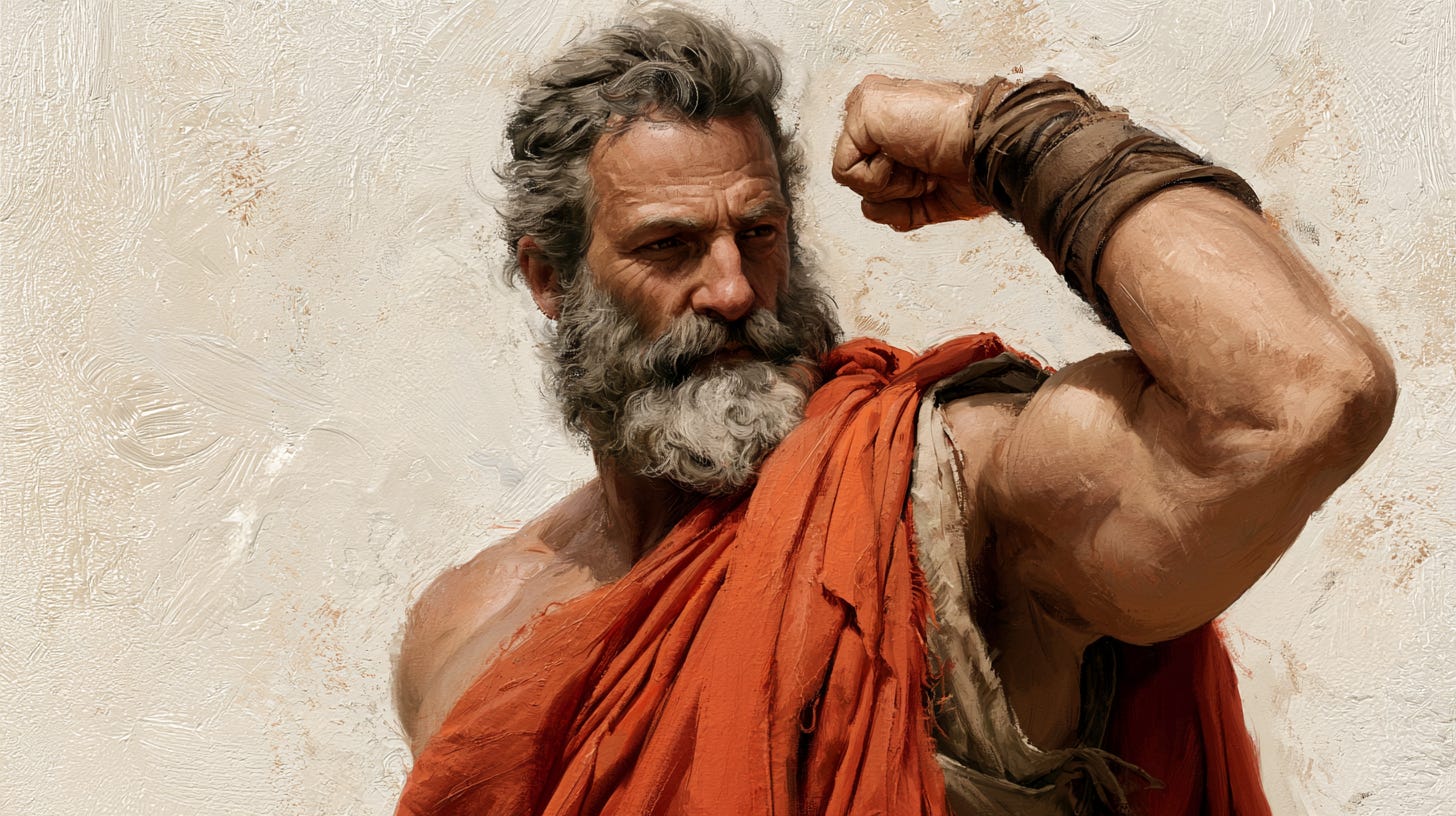
Seneca thought there was only one way to get that introduction. In his essay On Providence he imagines speaking to someone who has had an easy run through life, and he does not envy them. He pities them.
“You have passed through your life without meeting an antagonist: no one will know your powers, not even you yourself.”
Seneca, On Providence, 4.3
He goes on to say that no one ever learned what they could do without being put to the test. There is no way to look inward and read the number. So whatever else a hard season is, it is also the only time anyone takes your measure, and the easy years, for all their comfort, leave you a stranger to yourself.
That changes what to do with the question that shows up at three in the morning during the sleepless night.
“Can I handle this?”
It has no answer at three in the morning, or at any hour before the thing itself. You are asking for a measurement that can only be taken afterward. Knowing that is a kind of permission to stop asking, and Epictetus offers something better to ask in its place. In the Enchiridion, the short handbook of his teaching, he tells his students that whenever something happens to them, they should turn to themselves and ask what faculty they have for dealing with it. Faced with hard labor, he says, you will find endurance. Faced with insult, you will find patience.
His wording is that you will find it, with no maybe attached.
The Stoics believed a human being comes equipped for a human life, and that the equipment shows itself when it is called for and not a minute before. Strength, on this view, is something that gets called up when needed. That explains why a search for it on a calm day comes back empty, and why you worry it isn’t there.
If strength arrives on demand, then waiting until you feel strong enough means waiting for something that only comes after you begin. So begin before you feel ready. And ask only what today demands, because nobody is ever handed the whole thing at once. Some days the demand is patience. Some days it is one phone call you do not want to make. Some days it is only getting to bed and trying again tomorrow. Do that much, and leave the rest to the taller person who will be standing here later.
None of this settles the worry about speed. You can accept that you got through things and still feel that it took too long, that others your age are far ahead, that you keep having to learn the same lesson again. The Stoics have a good answer to this, and his name is Cleanthes.
He was a boxer who, the story goes, arrived in Athens with four drachmas to his name and became a student of Zeno, the founder of the school. To pay his way he spent his nights drawing water in a garden and his days studying. He was too poor for papyrus, so he is said to have written down Zeno’s lectures on oyster shells and the shoulder blades of oxen. He was also slow. The other students noticed, and they called him the donkey. Cleanthes did not argue. He said a donkey was the only animal strong enough to carry Zeno’s load.
He studied under Zeno for nineteen years. When Zeno died, the school did not pass to one of the quick ones. It passed to the donkey.
Cleanthes never entered the comparison with the quick students, because he could not win it and it measured nothing he cared about. The only fair comparison is with your own last mark, and against that one a slow person who keeps going wins every time. He also did not wait for better conditions. There was no money, so there were night shifts. There was no papyrus, so there were oyster shells. Whatever you are trying to build, some rough version of it is possible with what you have this week, and the rough version is where everyone who finished anything began.
The Stoics had a word for someone in his position, and in yours. Prokopton, the one who is making progress. It was the most any of them claimed to be. Seneca wrote flatly that he was not a wise man and never would be. So the feeling of not being there yet does not separate you from the people who lived well. It was their condition too, every one of them, for their whole lives. There is no finished group that you are failing to join.
What does progress look like, then, if nobody arrives? The best answer I know comes from Hecato, a Stoic whose books are all lost. It survives only because Seneca copied it into a letter to his friend Lucilius as the best thing he had read that day. Hecato puts the question to himself, and you would expect a list in reply. Anger mastered, fear defeated. His whole answer is one sentence.
“What progress, you ask, have I made? I have begun to be a friend to myself.”
Hecato, quoted in Seneca, Letters to Lucilius, 6.7
Only begun. A friend is the person who remembers what you have come through when you have forgotten it, who keeps the doorframe on your behalf. Hecato’s progress was that he had started keeping his own.
You can start keeping yours tonight, and it takes ten minutes. Write down three things you once believed you could not get through, and next to each one, what you were afraid would happen and what happened instead. Then write down the thing that worries you now, put today’s date on it, and keep the page somewhere you will find it. I wish someone had told me to do this at twenty. I would have spent far fewer nights certain that this time was different. And when you catch yourself being cruel about your own progress, ask whether you would say the same thing to a friend in your exact situation. You would remind them what they have already survived, and then you would ask what they need today. You are allowed to do that for yourself.
Seneca adds a comment under Hecato’s line. A person like that, he says, can never be alone, and is a friend to all mankind. When someone’s own bad day arrives, they go looking for a person who has been through something and come out steady, someone who can say from experience that the math done at night is wrong. Every day you got through is one you can now help somebody else through. Your strength was never only for you.
The next hard day will look impossible when it arrives, because it will stand above your last mark. By the time it is over, so will you.
